Well Water Testing
Well water tests cost $50–$300 per test. See what EPA says to test every year, county health department prices, and get quotes from local testing pros.
- Softeners $1,200–$3,800 installed (HomeGuide)
- Iron filtration $1,000–$3,500 installed (HomeGuide)
- Free quotes from licensed local contractors
Fast response from independent local providers. No obligation.
Typical national cost$1,200 – $3,600Cost guide →About Well Water Testing
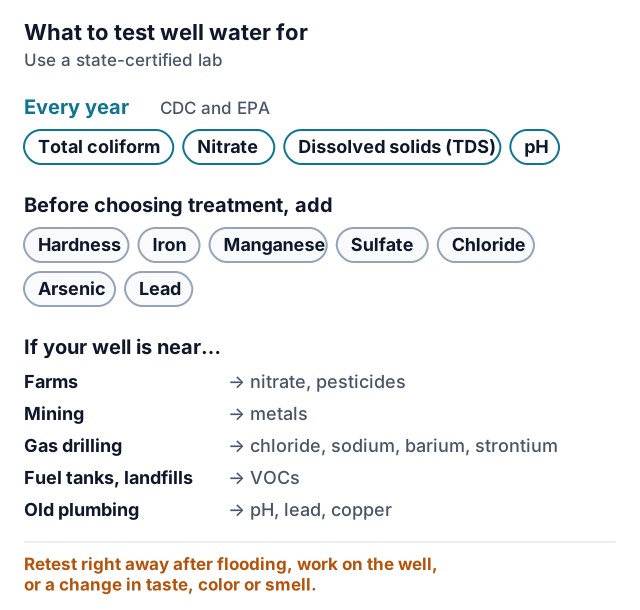
EPA doesn't regulate private wells, so testing is up to the owner. EPA's private-well guidance recommends testing every year for total coliform bacteria, nitrates, total dissolved solids and pH. It recommends testing more often when infants, elderly people or pregnant women live in the home. It also recommends using a state-certified lab and checking with your local health department.
What else to test depends on where you live. In Union County, NC, about one in five private wells tested by the state lab came back above EPA's 10 µg/L arsenic standard. In McLennan County, TX, deep Trinity wells run high in dissolved solids. Our market pages list what the local data shows, and the softener calculator's lab check compares your report with EPA's numbers.
Test first, buy second. Beyond the yearly four, add hardness, iron, manganese, sulfate, chloride, arsenic and lead when you're buying a home or noticing stains, odor or scale: those are the results a treatment pro sizes equipment from. Retest for bacteria after flooding, work on the well, or a change in taste or smell. If you live near farms, gas drilling, landfills or industrial sites, ask your health department what else to add.
Use a state-certified laboratory; your county health department or state cooperative extension can point you to one. HomeGuide puts a health-department bacteria and nitrate test at $25–$50, a standard lab panel at $100–$200 and a comprehensive panel at $200–$400, and Angi says $50–$300 per test. A free in-home test from an equipment salesperson is not a substitute for a lab report.
Common Jobs We Route
- Annual bacteria + nitrate screen ($25–$50 via a health department)
- Standard lab panel ($100–$200)
- Comprehensive panel ($200–$400)
- Full scan ($300–$500+)
- Pre-purchase or real-estate test
- Treatment-planning panel: hardness, iron, manganese, sulfate, chloride, arsenic, lead
- Post-shock-chlorination retest
- Radionuclide package where geology warrants ($300)
What Affects the Price
Providers quote their own work — these are the factors that consistently move the number.
- Number of parameters (single test vs panel)
- Health-department vs private-lab pricing
- Staff sampling visit vs self-collected (Franklin NC bacteria $40 vs $75 with visit)
- Specialty tests: arsenic speciation $80 in Union NC; iron bacteria $34 and sulfur bacteria $45 in Johnston NC
Well Water Testing FAQs
How often should I test my well?
EPA says at least once a year for total coliform, nitrates, TDS and pH, and more often if someone in the home is an infant, elderly or pregnant.
When should I test again between yearly tests?
CDC's well-testing guidance adds a test when you hear about well water problems in your area; after flooding, land disturbance or a nearby waste site; after you replace or repair any part of the well system; when the water's taste, color or smell changes; and when someone in the home becomes pregnant or a child comes to live with you.
What should I test for before buying treatment equipment?
The yearly four (total coliform/E. coli, nitrate, pH, TDS) plus hardness, iron, manganese, sulfate, chloride, arsenic and lead. Those results decide whether you need a softener, an iron filter, UV, RO or a neutralizer, and in what order.
What if my results show a problem?
If results show harmful germs or chemicals, CDC advises using bottled water or another safe source and contacting your health department. Only choose treatment equipment after testing, and keep the lab's name and the sample date with your report.
Is a health department test cheaper than a private lab?
Often. Johnston County NC charges $29 for an applicant-collected total coliform test; HomeGuide's private-lab standard panels run $100–$200.
Do I need to test after shocking my well?
Yes. Shock chlorination guidance says to retest for coliform and E. coli 7–14 days later. If it's still positive, a treatment pro can talk through UV or finding the source.
Need well water testing?
Send the short form — no obligation.