Well Water Treatment & Filtration System Cost (2026)
There is no single 'well water treatment system.' There is a sequence of parts chosen from your test results: a sediment filter to catch grit, an iron or sulfur filter if the water stains or smells, a softener if it's hard, UV if bacteria have shown up, and reverse osmosis at the kitchen tap for nitrate, arsenic or dissolved solids.
Angi's 2026 data puts a typical installed system at $1,200–$3,600. The spread comes from how many of those stages you need and how much flow your house uses: a 5 GPM system for one or two people runs $400–$1,200, and a 20+ GPM system for a large home runs $4,500–$10,000. The most expensive mistake is buying equipment before testing.
Typical national range
$1,200 – $3,600
avg $2,300 (Angi, May 2, 2026)
Cost breakdown
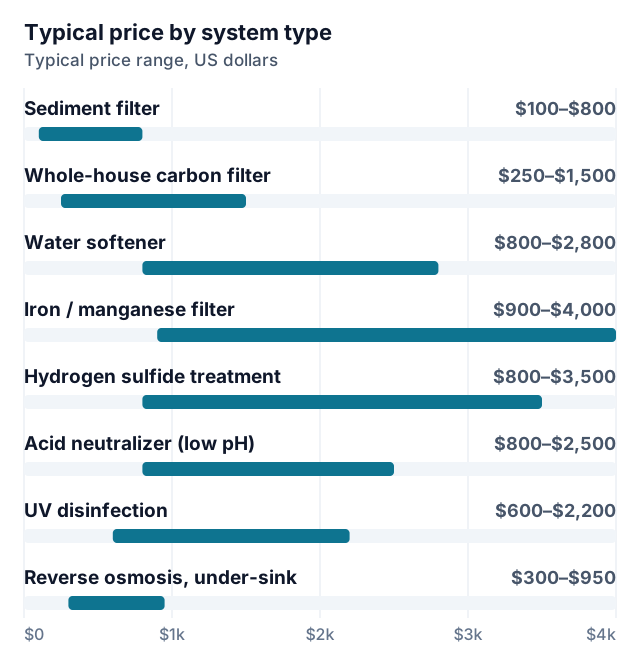
| Item | Typical range | Notes |
|---|---|---|
| Sediment filter | $100 – $800 | Angi; HomeGuide $150–$500 |
| Carbon filter (whole house) | $250 – $1,500 | Angi; HomeGuide $600–$2,000 |
| Water softener | $800 – $2,800 | Angi; HomeGuide filtration guide $1,000–$3,500 (its softener guide: $1,200–$3,800) |
| Iron / manganese filter | $900 – $4,000 | Angi; HomeGuide $1,000–$3,500 |
| Hydrogen sulfide (rotten-egg odor) treatment | $800 – $3,500 | HomeGuide |
| Acid neutralizer (calcite, low pH) | $800 – $2,500 | HomeGuide |
| UV disinfection | $600 – $2,200 | Angi; HomeGuide $700–$2,500 |
| Reverse osmosis (under-sink) | $300 – $950 | HomeGuide RO guide |
| Reverse osmosis (whole-house) | $4,000 – $10,000 | HomeGuide filtration guide (Apr 2026); its RO guide: $4,800–$8,000 |
| Multi-stage system | $2,500 – $10,000 | Angi and HomeGuide |
| Health-dept bacteria + nitrate test | $25 – $50 | HomeGuide |
| Standard lab panel | $100 – $200 | HomeGuide |
| Comprehensive panel | $200 – $400 | HomeGuide |
| Full scan | $300 – $500 | HomeGuide |
What changes the price
Providers quote their own work — these are the factors that consistently move the number.
- What the test finds: one problem means one stage; three problems mean a multi-stage train.
- Flow rate / house size: 5 GPM $400–$1,200 vs 20+ GPM $4,500–$10,000.
- Point-of-use vs whole-house: under-sink RO costs $300–$950 and whole-house RO $4,800–$8,000 in HomeGuide's RO guide; its filtration guide puts whole-house RO at $4,000–$10,000.
- Plumbing and electrical: bypass loops, drains and circuits add $100–$900 each.
- Operating costs: salt, lamps, media and membranes add $100–$500 a year.
Cost by problem (what your test found)
All figures are installed ranges from HomeGuide's well water filtration guide (Apr 2026), with the EPA reference for each. HomeGuide's separate softener guide puts a softener at $1,200–$3,800.
Hardness → Softener $1,000–$3,500 (no health standard, aesthetic). Iron → Oxidizing / iron filter $1,000–$3,500 (0.3 mg/L secondary). Manganese → Filter $1,000–$3,000 (0.05 mg/L secondary). Rotten-egg odor (H2S) → Oxidizing / aeration $800–$3,500 (odor 3 TON secondary). Bacteria → UV $700–$2,500 (total coliform MCLG zero). Nitrate → RO or anion exchange $300–$5,000 (10 mg/L as N MCL). Arsenic → Arsenic system $1,000–$4,000 (10 µg/L MCL). Lead → Filter / RO $300–$2,000 (15 µg/L action level, 10 µg/L from Nov 1, 2027). Low pH → Calcite neutralizer $800–$2,500 (6.5–8.5 secondary).
What each system removes
Sediment filter: sand, silt and cloudiness. Water softener: hardness and small amounts of iron. Iron / manganese filter: iron, manganese and some sulfur. Hydrogen sulfide treatment: rotten-egg odor. Acid neutralizer: low pH and corrosive water. UV: bacteria and viruses. Whole-house carbon: taste, odor and some VOCs. Under-sink RO: nitrate, arsenic and lead at the drinking tap.
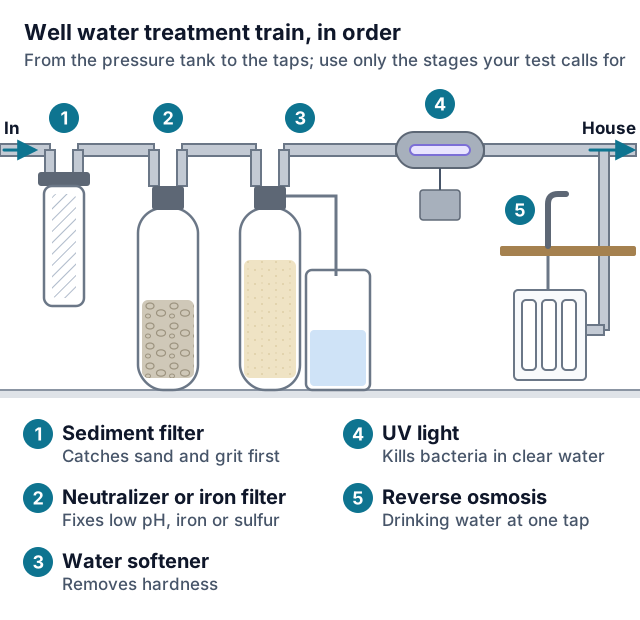
Install order: the treatment train
A typical train runs sediment filter first, then the neutralizer or iron filter, then the softener, with UV last so the water is clear when it reaches the lamp. Reverse osmosis sits at a single tap for drinking water, after everything else.
Most wells with more than one problem need two or three of these components, and putting them in the wrong order shortens the life of the ones downstream.
Worked example: hard water with iron and sediment
Take a well whose test shows hardness and iron, and whose water runs cloudy after rain. Using HomeGuide's installed ranges: water softener $1,200–$3,800 (its softener guide), iron / manganese oxidizing filter $1,000–$3,500 and sediment filter $150–$500 (its filtration guide). Adding the low ends and the high ends gives $2,350–$7,800 for the three stages.
That total is our own sum of published ranges, not a quote. Loop/bypass plumbing ($200–$500) and a backwash drain ($100–$300) can add to it, and a fair bid should itemize the same lines.
Softener prices
Water softener installation averages $1,500 (Angi) with a normal range of $200–$6,000. HomeGuide's softener guide puts the installed cost at $1,200–$3,800 (its broader filtration guide says $1,000–$3,500). Unit price by size (Angi, materials only): 24,000 grains $300–$500 up to 96,000 grains $1,700–$2,500. Add labor of $150–$1,000.
Sizing method: people × gallons/day × hardness (gpg) × days between regenerations. Before you buy, if iron is above about 1–2 ppm, HomeGuide advises a separate iron filter first.
Installation and add-ons
Installation overall $200–$2,000. Simple filter install $150–$300. Multi-stage install $500–$2,000. Loop/bypass $200–$500. Electrical $100–$400. Backwash drain $100–$300. Permits $50–$500 where required.
Ongoing costs
All equipment: $100–$500/yr; $1,000–$5,000 over 10 years. Salt $40–$120/yr (Angi) or $50–$150/yr (HomeGuide); Angi prices salt at $5–$10 per 40-lb bag. UV lamp $50–$150/yr. Sediment cartridges $5–$30 and carbon cartridges $20–$80 each. RO membrane $50–$200. Iron media $200–$600 per change.
Ask each installer for a five-year cost (equipment, install and upkeep), not just the install price.
How location changes the number
Union County, NC: 19.5% of tested wells were above EPA's arsenic standard → arsenic systems $1,000–$4,000.
Johnston County, NC: 32.7% were above the iron secondary standard and 38.6% were below pH 6.5 → iron filter plus neutralizer.
Franklin County, NC: acidic water and a radon-prone granite area → pH neutralizer; radon and uranium tests at $100 each.
Parker County, TX: median hardness 247 mg/L (~14 gpg) → softener sizing.
McLennan County, TX: deep wells high in TDS (52 of 52 above 500 mg/L); shallow alluvium wells with nitrate → RO.
Marion County, FL: nitrate in the Silver Springs basin → nitrate test first, then RO.
Frequently Asked Questions
How much does a whole-house water filter for a well cost?
HomeGuide's average is $1,500–$5,000 installed, and a typical combined setup runs $3,000–$7,000. Angi's typical system is $1,200–$3,600.
Do I need to test before buying a system?
Yes. EPA recommends yearly testing for coliform, nitrate, TDS and pH, and the results decide which equipment you need. A health-department screen can cost as little as $25–$50.
Will a water softener fix all my well water problems?
No. A softener handles hardness and small amounts of iron. Bacteria, nitrate, arsenic and low pH need other treatment.
Can I install a well water treatment system myself?
Simple cartridge filters and under-sink RO units are DIY-friendly. Softeners and iron filters need plumbing and drain connections and usually have to meet local code, so most owners hire a pro.
Does treatment lower my water pressure?
Each stage adds some pressure loss. If pressure drops after installation, check the pump and pressure tank before blaming the new equipment.
Estimates only — independent local providers quote their own pricing. Data last reviewed 2026-10.
Sources
- Angi — Well Water Treatment Systems Cost (May 2, 2026) (third-party estimate)
- Angi — Water Softener Installation Cost (Aug 3, 2026) (third-party estimate)
- HomeGuide — Well Water Filtration System Cost (Apr 2026) (third-party estimate)
- HomeGuide — Water Softener Cost (Jul 2025) (third-party estimate)
- HomeGuide — Reverse Osmosis System Cost (Jul 2025) (third-party estimate)
Prefer to just talk to someone?
Send the short form — we'll route you to an independent local pro.