Iron Filter & Sulfur Treatment Cost for Well Water (2026)
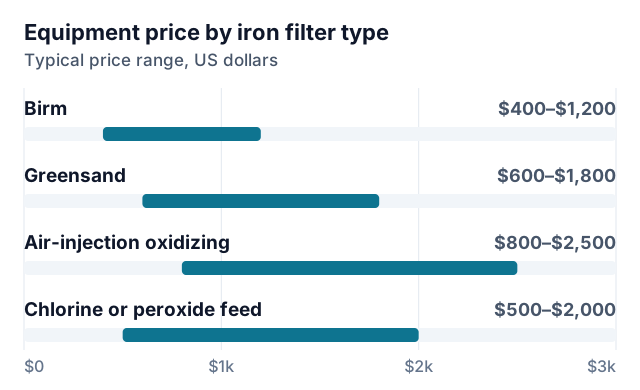
A whole-house iron filter for a private well costs $900–$4,000 installed, according to Angi (May 2026); HomeGuide puts iron and manganese filters at $1,000–$3,500. The equipment alone runs from $400–$1,200 for a Birm unit to $800–$2,500 for air injection. Treating a rotten-egg (hydrogen sulfide) smell runs $800–$3,500 installed.
Orange stains, black specks and a rotten-egg smell are the three complaints behind most iron-filter quotes. EPA's secondary (aesthetic) standards are 0.3 mg/L for iron and 0.05 mg/L for manganese; above those, expect orange and black staining on fixtures and laundry. These limits are non-enforceable and cosmetic, but they're what installers size equipment against.
A softener can cope with small amounts of dissolved iron. HomeGuide advises a dedicated iron filter ahead of the softener above about 1–2 ppm, and NDSU Extension puts the ceiling for standard softeners at about 10 ppm of iron and manganese. Past that point you're pricing an oxidizing filter, and the right type depends on the iron level, the pH and whether hydrogen sulfide is in the water too.
Typical national range
$900 – $4,000
installed iron filter (Angi, May 2, 2026)
Cost breakdown
| Item | Typical range | Notes |
|---|---|---|
| Iron filter, installed | $900 – $4,000 | Angi |
| Iron / manganese filter, installed | $1,000 – $3,500 | HomeGuide |
| Birm filter (equipment) | $400 – $1,200 | HomeGuide; iron under ~3 ppm, pH above 6.8 |
| Greensand filter (equipment) | $600 – $1,800 | HomeGuide |
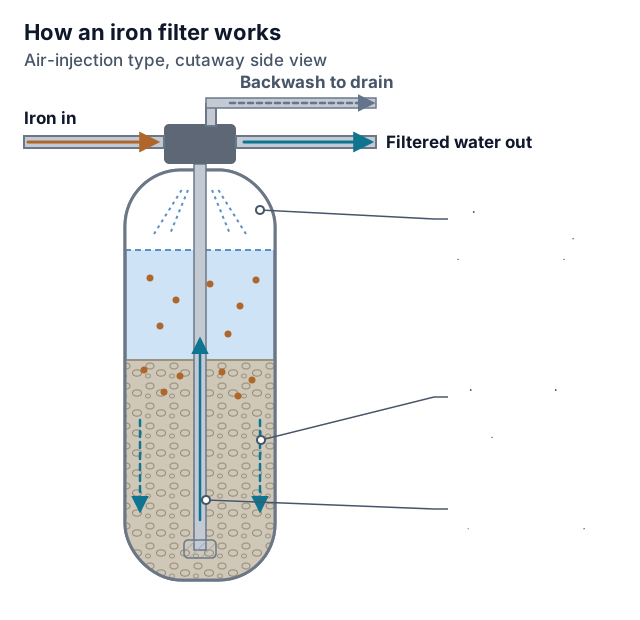
| Air-injection oxidizing filter (equipment) | $800 – $2,500 | HomeGuide; up to 10+ ppm iron |
| Chlorine or peroxide feed system (equipment) | $500 – $2,000 | HomeGuide |
| Hydrogen sulfide treatment, installed | $800 – $3,500 | HomeGuide |
| Manganese treatment, installed | $1,000 – $3,000 | HomeGuide |
| Acid neutralizer for low pH, installed | $800 – $2,500 | HomeGuide |
| Backwash drain line | $100 – $300 | HomeGuide |
| Iron filter media replacement (per change) | $200 – $600 | HomeGuide |
What changes the price
Providers quote their own work — these are the factors that consistently move the number.
- Iron level: Birm suits iron under about 3 ppm; HomeGuide lists air injection for 10+ ppm, and chemical feed for the heaviest loads.
- pH: Birm needs pH above 6.8, so acidic water may need a calcite neutralizer ($800–$2,500) ahead of the filter.
- Hydrogen sulfide or sulfur bacteria on top of the iron, which can mean air injection or peroxide feed instead of a plain media filter.
- Drain access: every backwashing filter needs a drain line ($100–$300).
- Running costs: media changes run $200–$600 each, and chlorine or peroxide feed supplies $10–$30 a month.
Orange stains vs black specks
Orange and rust-brown staining comes from iron; black specks and gray-black stains point to manganese. Both are covered by EPA's secondary standards (0.3 mg/L iron, 0.05 mg/L manganese). Ask the lab to report iron, manganese and pH together, since the pH decides which filter media will work.
Rotten-egg smell: which treatment, and what it costs
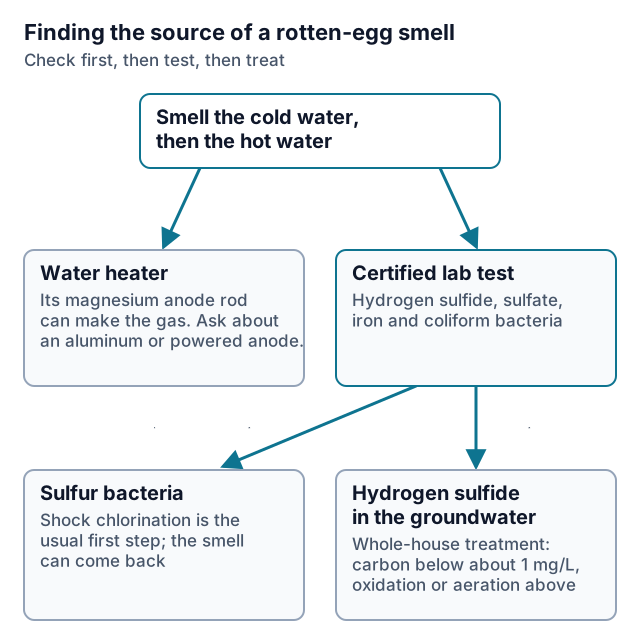
The smell usually comes from hydrogen sulfide gas or from sulfur bacteria. If only the hot water smells, the water heater's anode rod is often the culprit and no filter is needed. If the cold water smells too, air injection or peroxide treatment is the common fix; HomeGuide prices hydrogen sulfide treatment at $800–$3,500 installed.
Iron bacteria: slimy orange residue
A slimy orange or brown film in toilet tanks points to iron bacteria rather than plain dissolved iron. Shock chlorinating the well, followed by continuous treatment, may be needed. Some county labs test for it separately: Johnston County, NC charges $34 for iron bacteria and $45 for sulfur-reducing bacteria.
How location changes the number
Johnston County, NC: iron was above EPA's secondary standard in 32.7% of state-lab samples and manganese in 29.1%, and more than a third of samples were below pH 6.5, so iron filters here are often paired with a neutralizer.
Union County, NC: manganese exceeded 0.05 mg/L in 27.7% of tested wells and iron exceeded 0.3 mg/L in 18.6%.
Franklin County, NC: iron above standard in 21.4% of wells and manganese in 16.1%.
Parker County, TX: iron exceeded 0.3 mg/L in only 2 of 55 sampled wells, so a softener usually comes before any iron filter.
Frequently Asked Questions
At what iron level do I need a separate iron filter?
HomeGuide advises a dedicated iron filter ahead of the softener once iron is above about 1–2 ppm. NDSU Extension says standard softeners can handle up to about 10 ppm of iron and manganese, and Penn State Extension notes that red (already oxidized) iron fouls softener resin.
Will an iron filter get rid of a rotten-egg smell?
Only some types. Air-injection and peroxide-feed systems handle hydrogen sulfide; a basic Birm filter is aimed at iron. If only your hot water smells, check the water heater's anode rod before buying any filter.
How much does an iron filter cost to maintain?
HomeGuide puts iron filter media replacement at $200–$600 per change and chlorine or peroxide feed supplies at $10–$30 a month. The filter also backwashes to a drain, which uses water.
Is iron in well water a health risk?
EPA lists iron and manganese under its secondary standards, which cover cosmetic and aesthetic effects like staining and taste. Ask your county health department about your specific results.
Estimates only — independent local providers quote their own pricing. Data last reviewed 2026-10.
Sources
- EPA — Secondary Drinking Water Standards: Guidance for Nuisance Chemicals
- HomeGuide — Well Water Filtration System Cost (Apr 24, 2026) (third-party estimate)
- Angi — Well Water Treatment Systems Cost (May 2, 2026) (third-party estimate)
- NDSU Extension WQ1031 — Water Softening
- Penn State Extension — Water Softening
- Johnston County, NC Environmental Health — Fees (eff. Jul 1, 2026)
Prefer to just talk to someone?
Send the short form — we'll route you to an independent local pro.