Reverse Osmosis vs Water Softener for Well Water: Costs and Whether You Need Both
They solve different problems. A water softener takes hardness minerals (calcium and magnesium) out of all the water entering the house, which protects pipes, fixtures and appliances from scale. A reverse osmosis (RO) system pushes water through a fine membrane to strip out dissolved contaminants, and in most homes it's a small unit under the kitchen sink that makes drinking water.
Many well owners with hard water put in a softener first and an under-sink RO second. Which one you need, or whether you need both, comes from a lab test of your well, not from the equipment brochure.
At a glance
| Water softener (salt-based ion exchange) | Reverse osmosis | |
|---|---|---|
| What it treats | Hardness (calcium, magnesium); small amounts of iron (NDSU) | Dissolved solids and many contaminants, e.g. nitrate, arsenic, lead (HomeGuide) |
| Where it goes | Whole house (point of entry) | Usually one tap (under-sink); whole-house is possible |
| Installed cost | $1,200–$3,800 (HomeGuide); Angi: $200–$6,000, about $1,500 on average | Under-sink $300–$950; whole-house $4,800–$8,000 (HomeGuide) |
| Yearly running cost | Salt $50–$150/yr (HomeGuide); maintenance $100–$300+/yr (HomeGuide) | About $50–$250/yr in filters (HomeGuide) |
| Parts to replace | Resin over time; salt refills | Filters every 6–12 months; membrane every 2–5 years (HomeGuide) |
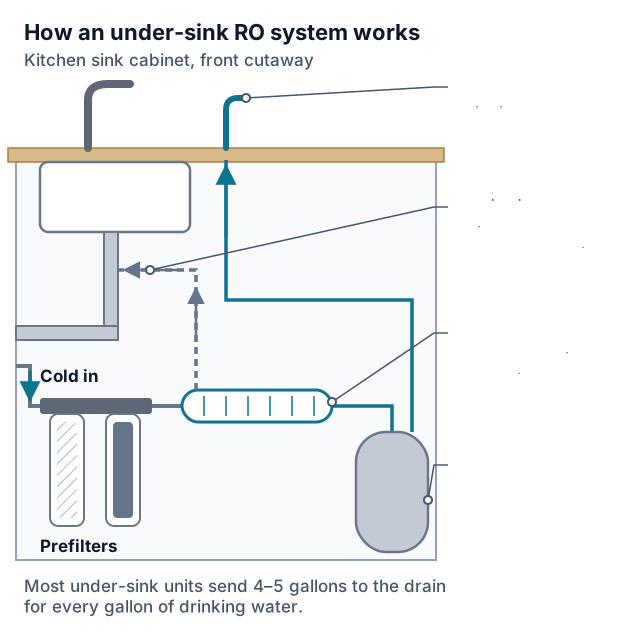
| Water use | Uses water to regenerate the resin | Most under-sink units send 4–5 gallons to drain per filtered gallon (HomeGuide) |
What's the difference between a water softener and reverse osmosis?
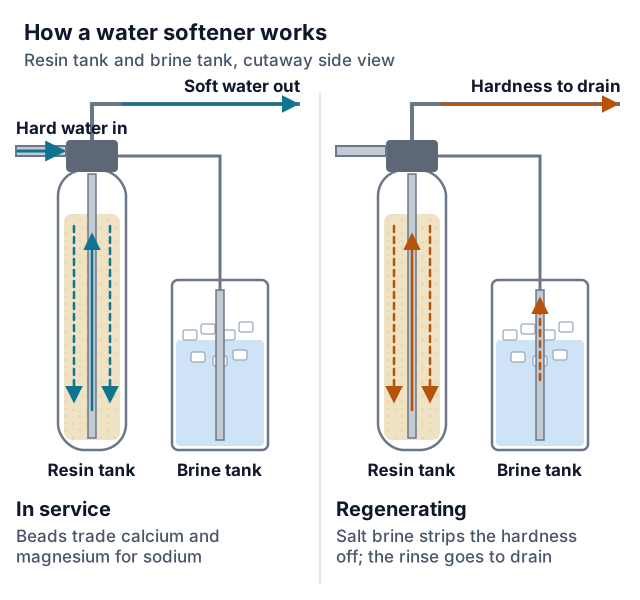
A softener swaps hardness minerals for sodium or potassium as water passes through a bed of resin beads, then flushes the beads with brine to recharge them. It changes the water's mineral makeup; it isn't designed to remove contaminants like nitrate or bacteria.
RO forces water through a semi-permeable membrane that rejects most dissolved substances. That's why it's the usual choice for drinking water, and why it sends some water down the drain as it works.
Can reverse osmosis replace a water softener?
Usually not for the whole house. Whole-house RO costs $4,800–$8,000 installed (HomeGuide), several times the price of a softener, and HomeGuide notes that RO needs an extra softening stage when the water is very hard, because hardness scales and clogs membranes faster.
In practice the softener protects the plumbing and an under-sink RO polishes the drinking water.
Do you need both?
You likely need both if your well test shows hardness and a drinking-water contaminant such as nitrate or arsenic, or if you want better-tasting drinking water from softened water.
A typical setup is a softener at the point of entry plus an under-sink RO at the kitchen tap: about $1,500–$4,750 installed in total using HomeGuide's ranges ($1,200–$3,800 plus $300–$950). That combined figure is our own sum of two published ranges, not a quote.
Which is better for well water? It depends on the test
Hard water only (scale, spotty dishes, soap that won't lather): a softener.
Iron staining: standard softeners can remove up to 10 ppm of iron and manganese (NDSU Extension WQ1031), but higher levels need a dedicated iron filter ahead of the softener.
Nitrate, arsenic or lead above limits at the kitchen tap: an under-sink RO.
Bacteria: don't rely on either one. Bacteria call for disinfection, such as UV, and a retest afterward.
Bad taste or odor: often carbon filtration; RO also improves taste (HomeGuide).
How much does each cost to run?
Softener: salt or potassium runs $50–$150 a year (HomeGuide; Angi prices salt at $5–$10 per 40-lb bag), plus $100–$300 or more a year in maintenance (HomeGuide).
RO: under-sink filters cost $20–$100 each and are changed every 6–12 months, with a new membrane every 2–5 years; HomeGuide puts typical upkeep at $50–$250 a year. Because most units send 4–5 gallons to drain for every gallon filtered, RO on a private well costs nothing on a water bill but does add load on the pump and the septic system.
What to do first, and the bottom line
Get a lab water test. EPA recommends testing a private well every year for total coliform bacteria, nitrates, total dissolved solids and pH, and the results tell you which of these systems you're shopping for.
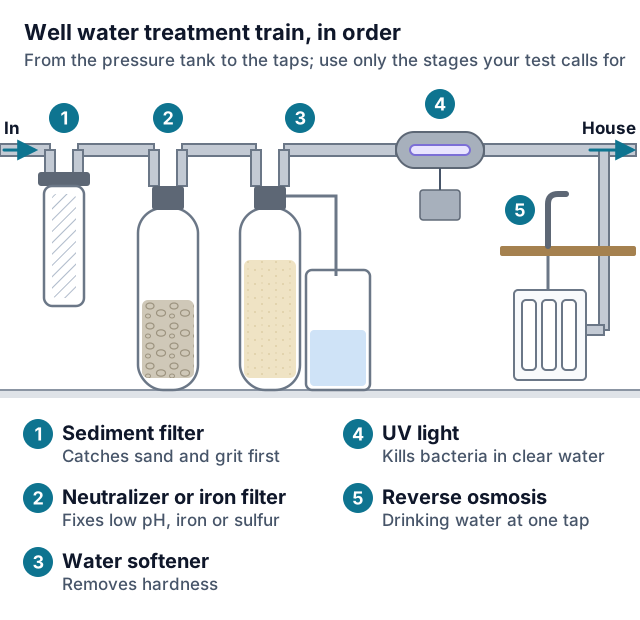
Buy a softener for hard water throughout the house. Buy reverse osmosis for drinking water with dissolved contaminants. Buy both if the test shows both problems, and install the softener ahead of the RO.
Frequently Asked Questions
Is reverse osmosis better than a water softener?
Neither is better overall; they do different jobs. A softener removes hardness minerals from all your water to prevent scale. RO removes dissolved contaminants, usually at one drinking tap. For hard well water with a contaminant like nitrate, most homes use both.
Does reverse osmosis remove hardness?
Yes. RO removes calcium and magnesium along with other dissolved minerals (HomeGuide). But very hard water shortens membrane life, and HomeGuide notes RO needs an extra softening stage with very hard water, so softening first is common.
How much does a reverse osmosis system cost?
An under-sink RO system costs $300–$950 installed and a whole-house system $4,800–$8,000, according to HomeGuide (checked Oct 13, 2026). Replacement filters for under-sink units run $20–$100 each.
How much does a water softener cost to install?
HomeGuide puts a salt-based softener at $1,200–$3,800 installed. Angi reports a $200–$6,000 range with most homeowners spending about $1,500 (updated Aug 3, 2026). Salt adds about $50–$150 a year (HomeGuide).
Should a softener go before reverse osmosis?
Yes. When you have both, the softener treats water at the point of entry and the under-sink RO comes after it at the kitchen tap. That protects the RO membrane from hardness scale.
Information only — not legal or financial advice. Data last reviewed 2026-10-13.
Sources
- HomeGuide: Water softener cost (third-party estimate)
- HomeGuide: Reverse osmosis system cost (third-party estimate)
- Angi: Water softener installation cost (updated Aug 3, 2026) (third-party estimate)
- NDSU Extension WQ1031: Water softening
- EPA: Protect your home's water (private wells)
Need help figuring out next steps?
Send the short form — we'll route you to an independent local pro.